
The Architecture of Extraction
AfroMax Investor Hub — The Problem, Part 2 of 2
Every major social media platform has a secret it keeps in plain sight: it makes more money when you feel worse.
Not because the people who built these platforms are malicious. Because of a structural truth that has never been resolved — and that the platforms themselves have no incentive to resolve. Understanding that truth is the foundation for understanding why AfroMax is not an improvement on what exists. It is a replacement.
The Original Sin of Social Media
In the beginning, the exchange seemed reasonable.
You get a free platform. You get to connect with people you care about, share what matters to you, discover content that interests you. In return, the platform serves you advertisements. You pay with attention, not money. Seemed fair.
What nobody fully understood at the time — including, arguably, the founders of these platforms — is what that bargain would eventually require.
To serve more advertisements, you need more attention. To get more attention, you need more time on the platform. To get more time on the platform, you need content that keeps people watching. And the content that keeps people watching longest is not the content that makes them feel good. It is the content that makes them feel something urgent — outrage, anxiety, envy, fear. The emotional states that are hardest to look away from.
The algorithm did not choose this because it was evil. It chose this because it was optimising for watch time, and watch time is what the ad business requires. The algorithm learned, through billions of data points, that emotional disturbance keeps people scrolling. So it served emotional disturbance. Not as a policy. As a mathematical conclusion.
This is the original sin. And every major platform is still living with its consequences.
The Tension That Cannot Be Resolved
Frances Haugen, the Facebook whistleblower, put it plainly in her 2021 Senate testimony: the platform's internal research showed that its products were causing harm — to teenagers, to democracies, to the mental health of its users — and the company chose growth over safety because growth served the ad business.
This was not a revelation to anyone paying attention. It was a confirmation.
The deeper point — the one that matters for investors evaluating AfroMax — is not that Facebook made bad choices. It is that Facebook could not have made different ones without dismantling the business model that made it valuable. The tension between what is good for the user and what is good for the platform is not a management problem. It is a structural one. It is baked into the foundation.
You cannot fix it with better moderation policies. You cannot fix it with algorithmic tweaks. You cannot fix it by hiring a Chief Wellbeing Officer or publishing a transparency report. The business requires attention. Attention is maximised by emotional disturbance. Emotional disturbance causes harm. The loop is closed. The only way out is to change what the business is selling — and no platform with billions in ad revenue is going to do that voluntarily.
What This Means for the Diaspora Specifically
For the Global Black Community, this structural problem has a specific and compounding dimension.
The ad-driven model does not just harm users psychologically. It actively excludes Cultural Ambassadors economically. As we established in Part 1, TikTok's Creator Rewards Program covers zero African countries. YouTube CPM rates for African markets are a fraction of Western equivalents. Spotify pays African artists less for identical streams.
These are not oversights. They are the logical output of an ad-driven architecture. The algorithm serves content to audiences that advertisers will pay to reach. Advertisers pay most to reach high-income Western consumers. African and Caribbean audiences — regardless of their actual spending power, regardless of their cultural influence, regardless of the size and engagement of their communities — are simply worth less to the ad market. So the platform pays them less. Suppresses their reach when it doesn't convert to ad revenue. Excludes them from monetisation programs entirely.
The culture that drives these platforms is produced by the communities the platforms value least. That is not a paradox. It is the architecture working exactly as designed.
Why the Majors Cannot Fix This
At this point a reasonable investor might ask: couldn't TikTok, Instagram, or YouTube simply decide to serve this community better? Build a dedicated product. Expand the Creator Rewards Program. Adjust the algorithm. Solve the problem from inside the existing infrastructure.
The answer is no — and understanding why is central to understanding AfroMax's moat.
To replicate what AfroMax is building, a major platform would need to simultaneously accomplish the following:
Retrain its core revenue from advertising to transactions — events ticketing, dating, direct community economics. Convince Wall Street to revalue it on a completely different multiple in the process. Rebuild Cultural Ambassador relationships around community depth rather than reach and impressions. Explain to its advertising partners why it is actively deprioritising watch time. Retrain years of algorithmic signal history built entirely around engagement and passive consumption. And do all of this while the existing ad revenue is still flowing — because stopping that flow before the new model is proven would be catastrophic.
That is not a pivot. It is a demolition and rebuild of a live building. It will not happen. The business model that made these platforms powerful is the same business model that makes them incapable of following AfroMax where it is going.
This is not a gap in their ambition. It is a constraint in their architecture.
The Only Way Out Is a Different Foundation
AfroMax's revenue comes from events ticketing, in-app virtual currency, and dating. Not ads.
This single fact changes everything downstream.
On AfroMax, the algorithm that serves the business is the same algorithm that serves the member. Moving people toward genuine connection — off the feed, into events, toward each other — is simultaneously the product and the revenue model. There is no tension between what is good for the member and what is good for AfroMax. They are, for the first time on any social platform at scale, the same thing.
The algorithm is not optimising for watch time because watch time is not what AfroMax sells. AfroMax sells connection. Events attended. Relationships formed. Tickets purchased because a Cultural Ambassador built a community worth showing up for. Bride Price sent because someone watched a video and felt something real before they sent a single message.
Every feature on the platform — Gold, Chill Together, Conversations, AfroMax Love, Events, Series, Camera, Gift — exists to move a member from passive consumption toward active human connection. Not because a product manager decided that was a nice value to have. Because that movement is the revenue model. The platform makes money when people genuinely connect. It makes nothing when they scroll alone.
That alignment is not philosophical. It is structural. And it is the foundation that every feature, every algorithm decision, and every product choice at AfroMax is built on.
The Architecture of the Platform
There is a technical way to describe what AfroMax has built and a human way to describe it.
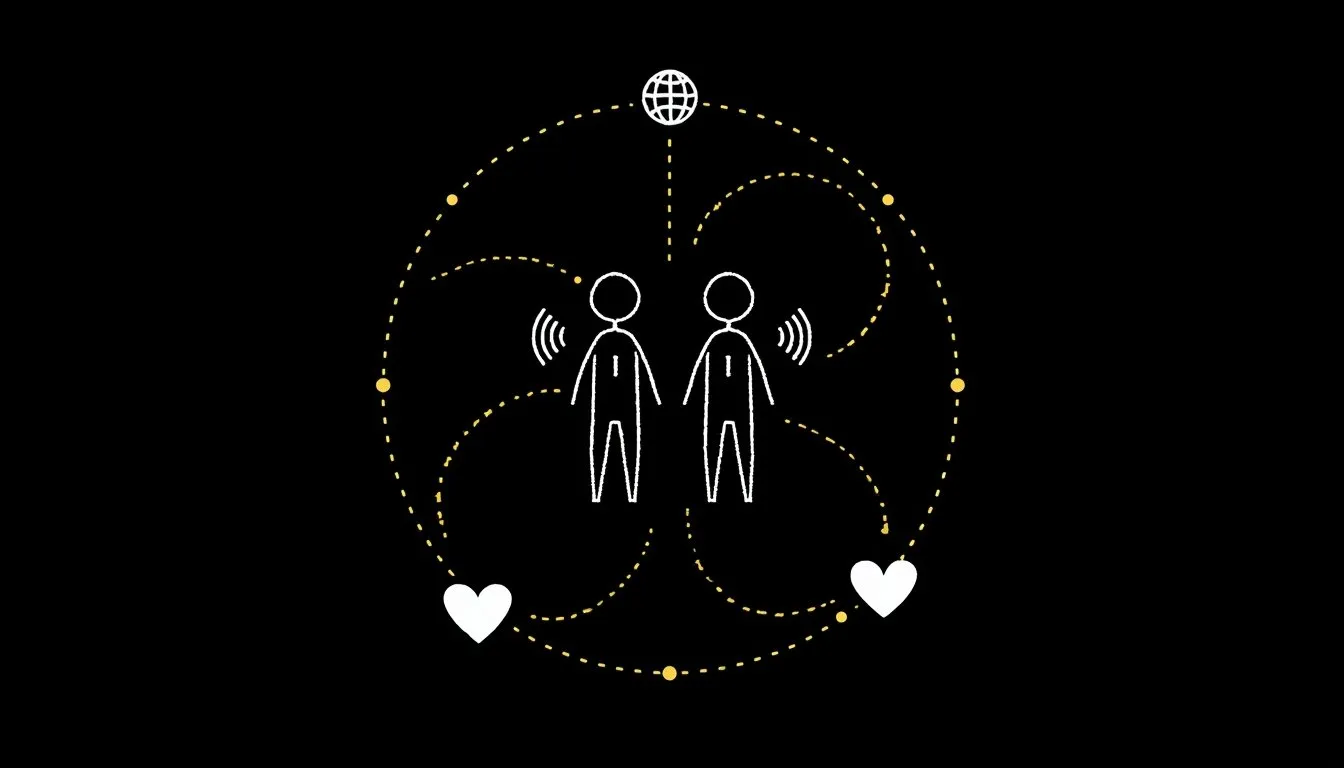
AfroMax inverts the architecture of every major social platform. On TikTok, Instagram, and YouTube, content delivery is the foundation — the relationship is bolted on top as a feature. AfroMax builds the relationship progression into the foundation layer itself, with content delivery sitting on top of it as the expression layer. Everything the platform serves — every video, every event recommendation, every match — is an output of where the member stands in their relationship to the community, not an input designed to maximise their time on screen.
The human way: AfroMax is built on Ubuntu — the African philosophical principle that says "I am because we are." The self is not prior to the community. Your identity emerges through relation. On every major platform, the individual is the atom — you build a profile, you accumulate followers, you amass content, and community is just many individuals in proximity. Ubuntu says the opposite. And AfroMax is built on that assumption architecturally, not just philosophically.
A new member does not arrive as a complete entity who then optionally joins things. They arrive as potential — and the platform's job is to move them toward more complete connection. The algorithm tracks that movement through five stages: from content, to Cultural Ambassador, to community, to event, to person. At every stage it is asking the same question every other platform never asks: where does this lead?
AfroMax Love does not have a churn problem because AfroMax is not a dating app. It is a cultural platform with a dating feature. When two people match on AfroMax Love, they do not graduate to WhatsApp and disappear. They are already embedded in a community — following Cultural Ambassadors, attending events, using Chill Together, building a shared life inside an ecosystem that was built for them. The relationship that began in AfroMax Love lives in AfroMax. There is nowhere else it fits as well.
AfroMax does not ask Cultural Ambassadors to leave TikTok or Instagram. It asks them to bring their audience somewhere those platforms cannot follow — into events, into community, into a platform that pays them based on what their community is worth, not what advertisers in their local market will pay.
Watch time is not the answer AfroMax is optimising for. The answer it is optimising for is the moment the door opens — and the member realises the room was never empty.
The Investment Thesis in One Paragraph
The major platforms are structurally incapable of serving the Global Black Community well because their revenue depends on selling attention, and attention is maximised by emotional disturbance rather than genuine connection. The Global Black Community — one of the most culturally generative and economically active communities in the world — has been paying the highest price for this architectural failure: suppressed content, excluded monetisation, a culture extracted and a community underserved. AfroMax is built on a fundamentally different foundation: a revenue model tied to genuine human connection, an algorithm aligned with member wellbeing rather than opposed to it, and a product architecture that treats the relationship as the foundation and content as the entrance. The platforms that dominate today cannot follow AfroMax where it is going. The business model that made them powerful is the same business model that makes them unable to change.
AfroMax is a video-first cultural lifestyle platform for the Global Black Community. Content, dating, and events — built for culture, not addiction. Learn more at afromax.app.
Previously: The Culture Was Never the Problem — the human case for why this community has been failed by every platform that profited from it.